The Old Mans Back Again Scott Walker
© David Turnley / Corbis / VCG via Getty Images
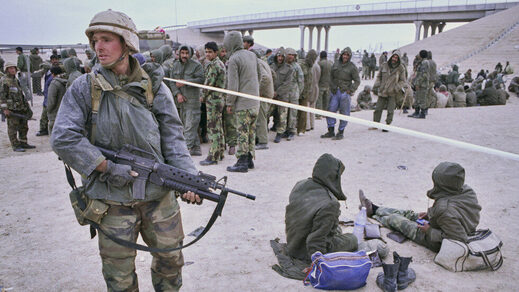
United States military personnel with an M16 burglarize, guarding prisoners of war near the 5th Mobile Army Surgical Infirmary, during the Gulf War, at King Abdulaziz Air Base of operations in Dhahran, Saudi Arabia, 1991.
The Pentagon is in the process of preparing options for President Joe Biden regarding the deployment of US forces into NATO'southward eastern flank to seek to deter Russia from acting against Ukraine, or threatening NATO'south easternmost members of Poland, Latvia, Estonia, and Republic of lithuania.
Some 8,500 United states troops have been put on standby to be prepared to deploy to Europe on brusque observe. These are the US contingent of the NATO Response Forcefulness, a multinational, 40,000-troop unit tasked with responding to aggression against member countries.
If the US wanted to do more, it could deploy a few squadrons of Usa Air Force fighters, along with another heavy armored brigade, whose equipment is prepositioned in Poland, and some support troops. Information technology could also transport 3,000 troops from the 82nd Airborne Division, which is tasked to "respond to crisis contingencies anywhere in the world within xviii hours."
All these troops, withal, even if assembled in aggregate, could not stand upward to a potential Russian adversary, for the unproblematic fact that none of these forces have trained to fight a modern combined arms conflict against a peer-level opponent. Putting troops and equipment on a battlefield is the piece of cake part; having them perform to standard is harder, and having them execute doctrine that is no longer in faddy is impossible.
Joe Biden might think he'south flexing hard with this talk of military ability projection. All he is doing, however, is further underscoring the absolute dismal state of combat readiness that the US military finds itself in after 20 years of depression-intensity conflict in a losing crusade.
The fourth dimension to accept deployed l,000 troops to Europe was in 2008, afterward the Russian-Georgian War, or 2014, after the Crimea crisis. Having fifty,000 well-armed US troops refocused on the difficult task of fighting a sustained footing disharmonize in Europe might take forced Russian federation to reconsider its options. By considering this choice now, all Biden is doing is proving the point that the US is a failing superpower, and NATO is lacking both purpose and drive.
A shadow of its former self
What a difference three decades makes. In 1990, the United states Army in Europe (USAREUR) consisted of some 213,000 combat-set forces organized into two Corps - V and VII - a Berlin Brigade, and the 3d Brigade of the 2d Armored Sectionalisation, deployed in northern Deutschland to protect the port of Hamburg. Each corps consisted of i infantry division, one armored division, and an armored cavalry regiment.
Through a program known as Return of Forces to Germany (REFORGER), USAREUR could be reinforced within ten days by some other three mechanized infantry divisions (one of them Canadien) and two armored brigades which would fill out Five and VII Corps to full strength, also every bit a 3rd corps (III Corps) consisting of two armored divisions, a mechanized infantry division, a cavalry regiment, and other corps-level troops.
These forces would fall in on prepositioned military stores warehoused and maintained to a level of abiding readiness. Between the forces in Europe and those earmarked for deployment, USAREUR boasted a total combat capacity of over 550,000 troops which helped maintain the peace during America's long Cold War with the Soviet Union, which had effectually 600,000 troops stationed in eastern Europe, including 338,000 in East Germany alone.
The potency of US forces back then went on display in the war to liberate Kuwait from Saddam Hussein's soldiers in 1991. USAREUR deployed a Corps Headquarters (the 7) along with 75,000 personnel, 1,200 tanks, one,700 armored combat vehicles, more than than 650 pieces of artillery, and more than 325 shipping to the Persian Gulf to support Functioning Desert Shield/Desert Tempest. A decade of intense combined arms warfare training in support of a new Air-Land Battle doctrine made the USAREUR forces the most combat capable units in the operation, helping beat out the world's fourth largest army in a 100-hour basis combat functioning that is unmatched in mod times.
After preserving the peace in Europe and winning a state of war in the Middle East, USAREUR was rewarded by being unceremoniously tossed into the trash bin of history. In 1992, later on the collapse of the Soviet Union, some lxx,000 soldiers redeployed to the continental United States, part of a withdrawal that saw USAREUR shrink to some 122,000 troops by the end of that year; 12 months subsequently, it was down to some 62,000 soldiers. The Cold War, we were told, was over, and there was no longer a demand to shoulder the expense of maintaining a standing forcefulness in readiness because, with the dissolution of the Warsaw Pact and the Soviet Union, there would never once more be a large-scale ground war in Europe.
By 2008, the concluding remaining Corps-sized headquarters in USAREUR, 5 Corps, was rated as the least valuable military asset in the entire Usa military in terms of power projection capabilities.
Monkey come across, monkey do
The US wasn't the only NATO power looking to cut costs in the postal service-Cold War era. In 1988 — a yr earlier the fall of the Berlin Wall — the West German Army was looking at a reorganization scheme that would retain its construction of 12 divisions with 48 brigades, only reduce the manning levels from 95% to a 'cadre structure' of merely 50%-70% that could exist brought to full force merely through the mobilization of reserves.
By 2020, the High german Ground forces, by now representing a unified country, had been reduced to little more than 60,000 troops organized into ii armored divisions of six brigades, and one rapid deployment division of two brigades. Only even this reduced figure is misleading - to deploy a combat-capable battalion-sized armored strength to the Baltics as part of NATO's 'battlegroup' concept, Frg has to cannibalize its existing armor force. Germany today is incapable of quickly deploying a single armored brigade from its barracks.
In 1988 the British Regular army of the Rhine (BAOR, representing the U.k.'s NATO contingent in Europe) consisted of some 55,000 troops organized into a unmarried armored corps consisting of three armored divisions with eight brigades and supporting units. By 2021, this had dropped to merely 72,500 troops in the entire British military, with no troops in mainland Europe. Moreover, the British are merely capable of fielding ii armored brigades, simply one of which is capable of projecting power in whatsoever meaningful chapters onto European soil in brusque notice.
Every other war machine in NATO has undergone similar reductions. Along with the drawdown in size came a similar reduction in training, both in terms of calibration and scope. Whereas REFORGER used to set soldiers to fight multi-division sized engagements using doctrine geared toward the employment of combined arms operations, today NATO carries out battalion- and brigade-sized grooming which focuses on depression-intensity conflict and "operations other than war" (i.east., peacekeeping, disaster response, etc.).
NATO today cannot fight a corps-sized engagement, even if information technology had a functioning corps-sized unit fit for grooming. The fact of the matter is that NATO is a mere shadow of its former self, militarily neutered, and incapable of projecting power in any meaningful capacity.
Of course, NATO wasn't the only European military arrangement to undergo reduction and restructuring. With the dissolution of the Soviet Wedlock in 1991, the Russian armed forces was in total disarray. In 1988, the Soviet military comprised some v.five million personnel; by 1998, this number had dropped to around 1.5 million. Once configured to defeat NATO and occupy western Europe, past 1998 the Russian army was not able to behave medium- or big-scale military exercises. Information technology had performed poorly in combat in Chechnya and had fumbled its internal reorganization and so badly that its ability to projection ability was virtually nil.
By 2000, things started to turn effectually. President Vladimir Putin had brought a semblance of purpose and discipline to Russian military service. Putin was motivated in part by the due east expansion of NATO, which, despite the promise made to former Soviet President Mikhail Gorbachev that NATO troops would non movement "one inch" eastward in the instance of German reunification, had assumed into its ranks not merely former Warsaw Pact nations, just also former Soviet Republics.
The Russian Army defeated a Chechen insurgency in the Second Chechen War (something the Usa military and NATO were unable to accomplish in twenty years in Transitional islamic state of afghanistan) and performed well in both the Georgian-Russian State of war of 2008 and the Crimea functioning in 2014. Moreover, largely in response to the eastward expansion of NATO, Russia reformed 2 Common cold War-era military formations — the 1st Guards Tank Army and the 20th Combined Arms Regular army — which specialized in the very kind of mobile, big-scale combined arms operations the United states armed forces and NATO have forgotten how to fight.
Flexing its way out of a fight
Without projecting Russian intent, the reality is that the Russian military buildup in its western and southern military districts, when combined with the deployment of mobile forces in Belarus, represent a armed forces ability projection adequacy that is not only more than than capable of defeating Ukraine, merely also NATO forces currently deployed on its eastern flank. The chances of such an all-out conventional-style war may be extremely slim, simply in that location is no doubting who holds the advantage here.
After years of behaving like a teenager shadow boxing in the basement of his mother'southward firm, playing out the fantasy of knocking out Ivan Drago in the 1985 movie Rocky Four, the US and NATO notice themselves against the reality of the state of affairs they themselves created. Having picked a fight with Russia in the belief that it was not stiff plenty to option up the gauntlet, the trans-Atlantic alliance is now confronted with the reality that Ivan Drago is alive and well and standing in the band, ready to exercise boxing.
On screen, Rocky IV was an entertaining movie with (if you're an American) a satisfying ending. In the mod-day remake being contemplated by Joe Biden and NATO, Rocky Balboa is little more than a effigy in their collective imagination. Rather than step into the band and encounter the challenge, all the US and NATO tin can practice is continue to flex, hoping that somehow Russia will exist taken in by the bluff and a pretense of power that simply no longer exists.
Scott Ritter is a erstwhile US Marine Corps intelligence officer and author of SCORPION Rex: America's Suicidal Embrace of Nuclear Weapons from FDR to Trump. He served in the Soviet Union as an inspector implementing the INF Treaty, in Full general Schwarzkopf's staff during the Gulf War, and from 1991-1998 as a Un weapons inspector. Follow him on Twitter @RealScottRitter
Source: https://www.sott.net/article/463719-Scott-Ritter-America-couldnt-defend-Ukraine-even-if-it-wanted-to

Post a Comment for "The Old Mans Back Again Scott Walker"